Test3
This test includes four, 2D clustering problems with different levels of nonlinearity regarding the separating hyperplanes, including concentric rings or the highly non-linear intertwined spiral clustering problem that are known to be difficult. The whole test is automatic i.e. the provided script is responsible for both generating and clustering of the data as well as producing some plots summarising the results of the individual clustering problems.
Description of the problem
The provided kscICholTest3.py \(\texttt{Python}\) script includes the generation of the data sets and execution of the KSC application with the pre-defined input arguments/parameters. After clustering the data sets, some plots are generated by the script to visualise the results of the clustering as well as additional information such as the reduced set points used to build the spare KSC model or the decision boundaries.
Each of the generated data sets contains four clusters, with 100 000, 2D data points with different shapes of the clusters:
\(\texttt{4Clusters}\) : Gaussians clusters with varying sigmas
\(\texttt{4Moons}\) : intertwined moon-shaped clusters
\(\texttt{4Circles}\) : concentric rings with different thicknesses
\(\texttt{4Spirals}\) : intertwined spirals
The test
The test can be executed as (or adding the \(\texttt{-v}\) flag as an input argument for the full verbosity of the KSC application printouts)
bash-3.2$ python kscICholTest3.py
 ==== (Python) === : clustering the  4Circles  data set ...
 ==== (Python) === : generating decision boundary for the  4Circles  data set ...
 ==== (Python) === : clustering the  4Clusters  data set ...
 ==== (Python) === : generating decision boundary for the  4Clusters  data set ...
 ==== (Python) === : clustering the  4Moons  data set ...
 ==== (Python) === : generating decision boundary for the  4Moons  data set ...
 ==== (Python) === : clustering the  4Spirals  data set ...
 ==== (Python) === : generating decision boundary for the  4Spirals  data set ...
This will generate the pre-defined data sets (listed above), perform the clustering by executing the \(\texttt{KscIchol}\_\texttt{Test}\) KSC application with the pre-defined input arguments. At the end, a plot for each clustering problem is generated containing the input data set, the training data set with the selected reduced set points, the clustering results as well as the decision boundaries. Intermediate data are stored in the \(\texttt{output}\) directory while the :math`texttt{res}` directory contains the generated figures shown in Fig. 19, Fig. 20, Fig. 21 and Fig. 22.
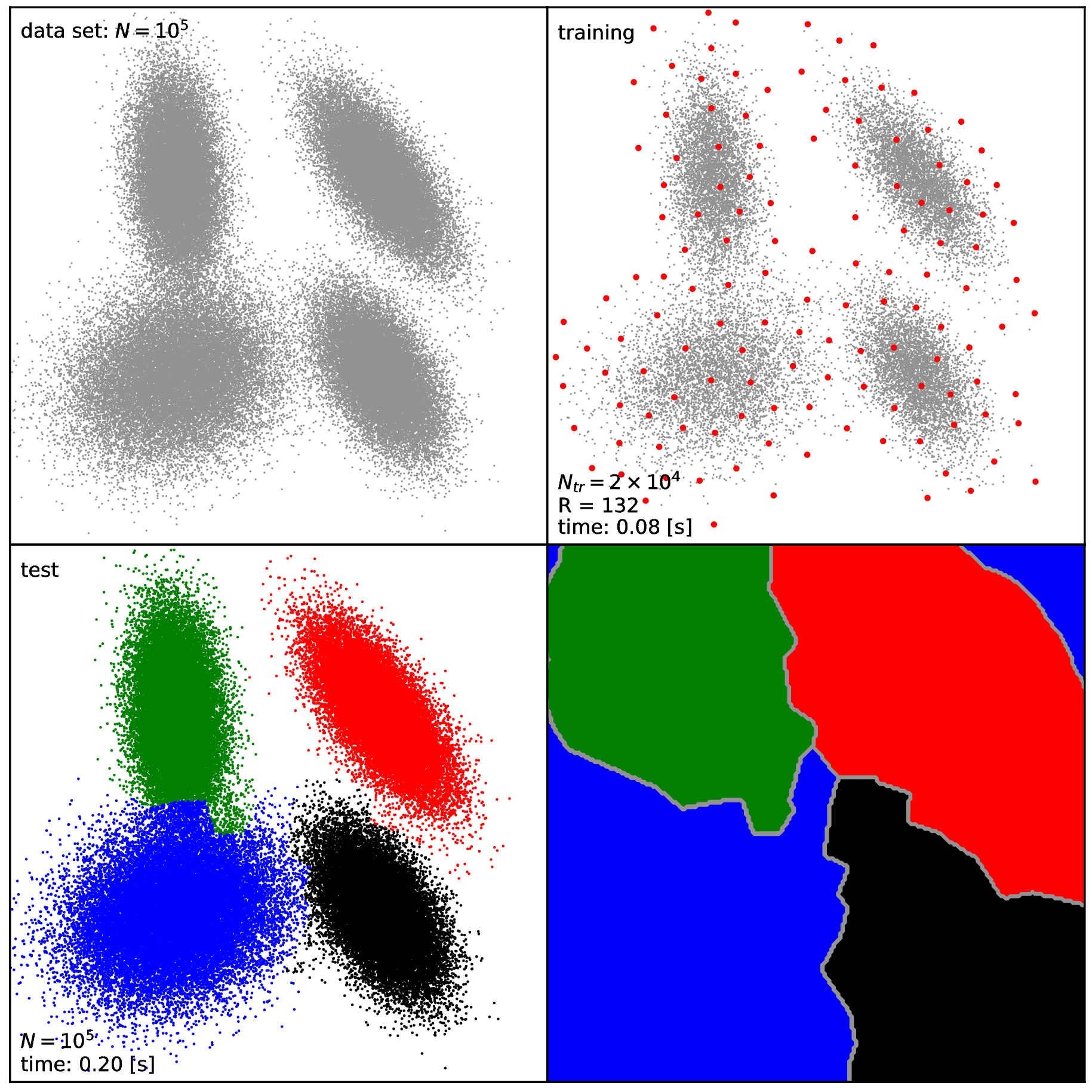
Fig. 19 Results of clustering the \(\texttt{4Clusters}\) data set: the whole ( \(N = 100 000\)) data set (top left), training data set and the reduced set points(red) (top right), cluster assignment of the whole data set as the final result (bottom left), division of the underlying 2D space by the corresponding KSC model (bottom right).
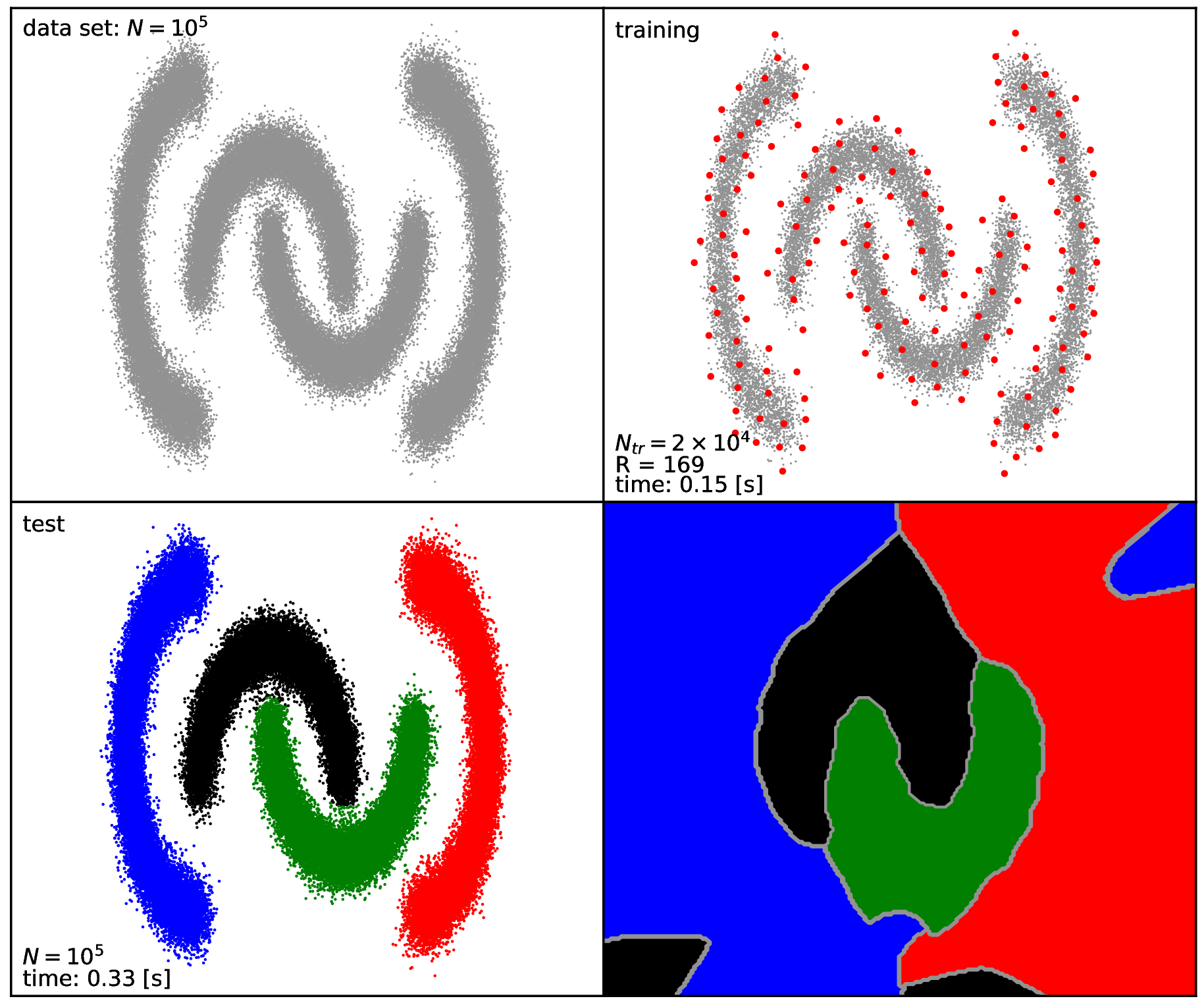
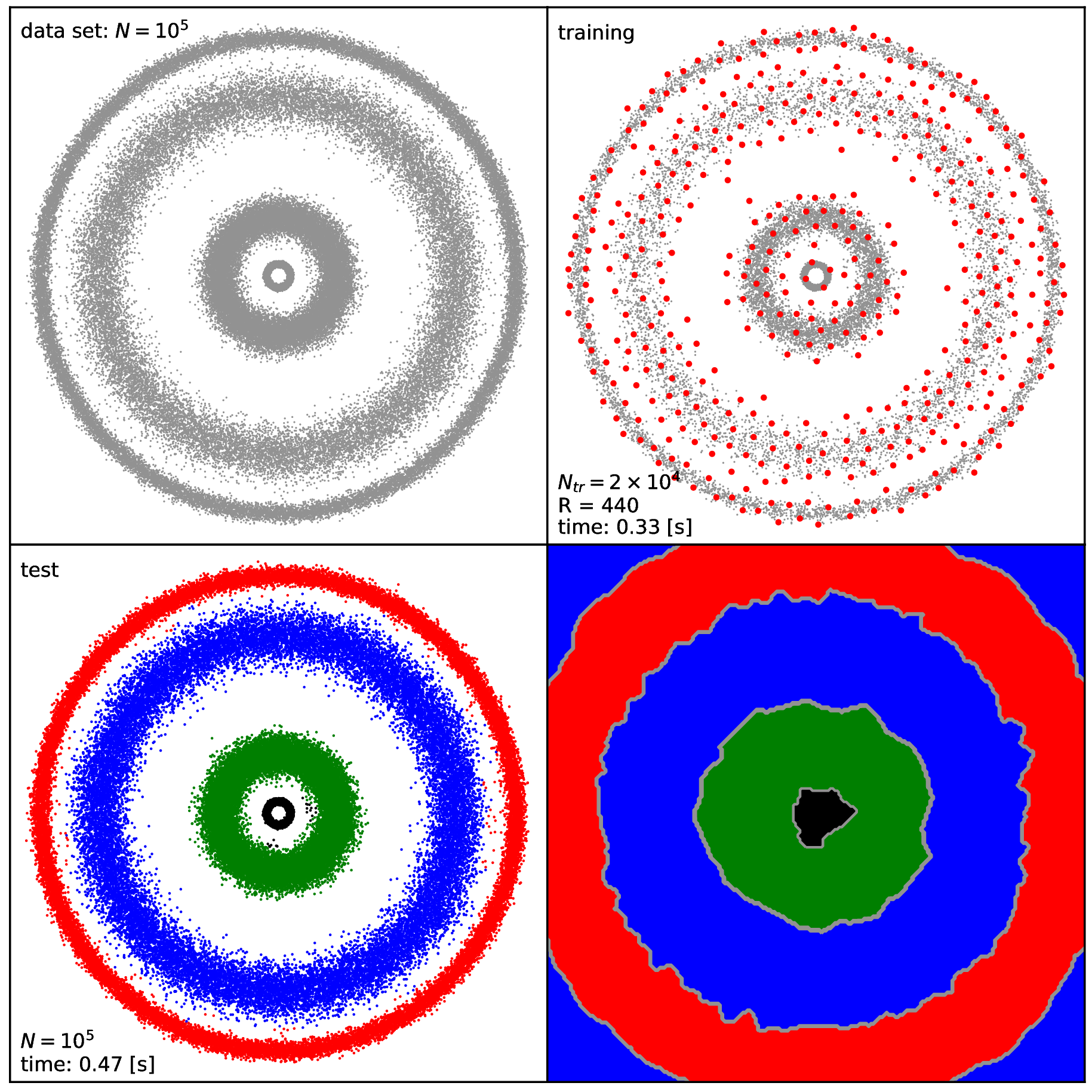

Note, that training the KSC model and clustering the whole \(N = 100 000\) data sets takes less than a second each (see the note below regarding the \(\texttt{4Spirals}\) problem).
Note
The provided script contains predefined parameters for the \(\texttt{KscIchol}\_\texttt{Test}\) KSC application(e.g. training data set size, maximum reduced set size, RBF kernel parameters, etc.) for each clustering problem. These parameter values were selected in a conservative way: not only providing good clustering results but also smooth decision boundaries. Therefore, similarly accurate clustering can also be obtained even by using more relaxed KSC application parameters. As an example, the clustering of the \(\texttt{4Spirals}\) data set, obtained by using the following change in the original input argument
--icholTolError       = 0.6    ---> 0.9
--icholRBFKernelPar   = 0.0006 ---> 0.0009
--clRBFKernelPar      = 0.005  ---> 0.0016
shown in Fig. 23
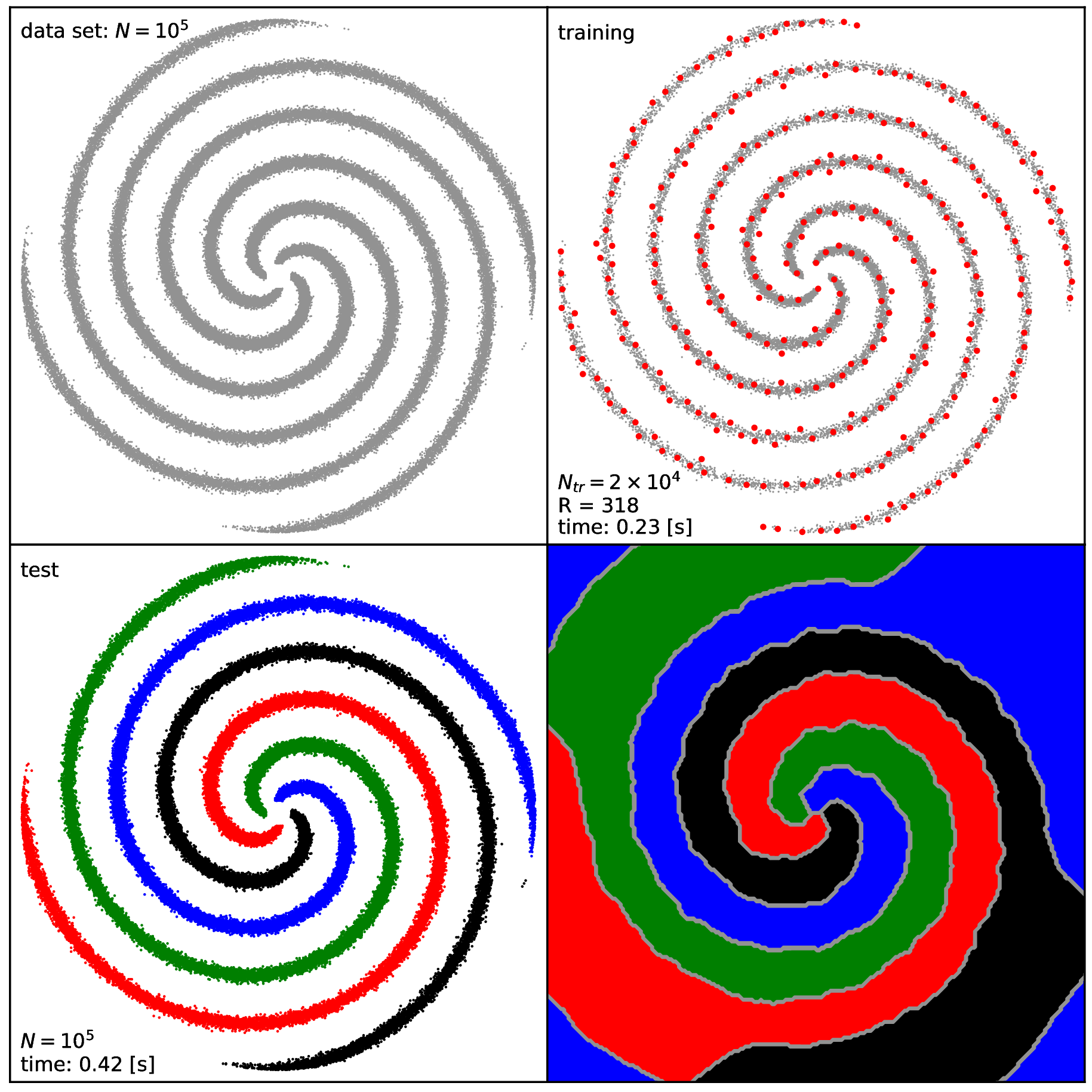
Fig. 23 Same as in case of Fig. 22 but with the modified input argument of the \(\texttt{KscIchol}\_\texttt{Test}\) KSC application mentioned above.
Note, that the number of reduced set size used in the relaxed case drops to 318 compared to the original 800 while the quality of the clustering result practically not influenced at all (the decision boundaries are less smooth though).